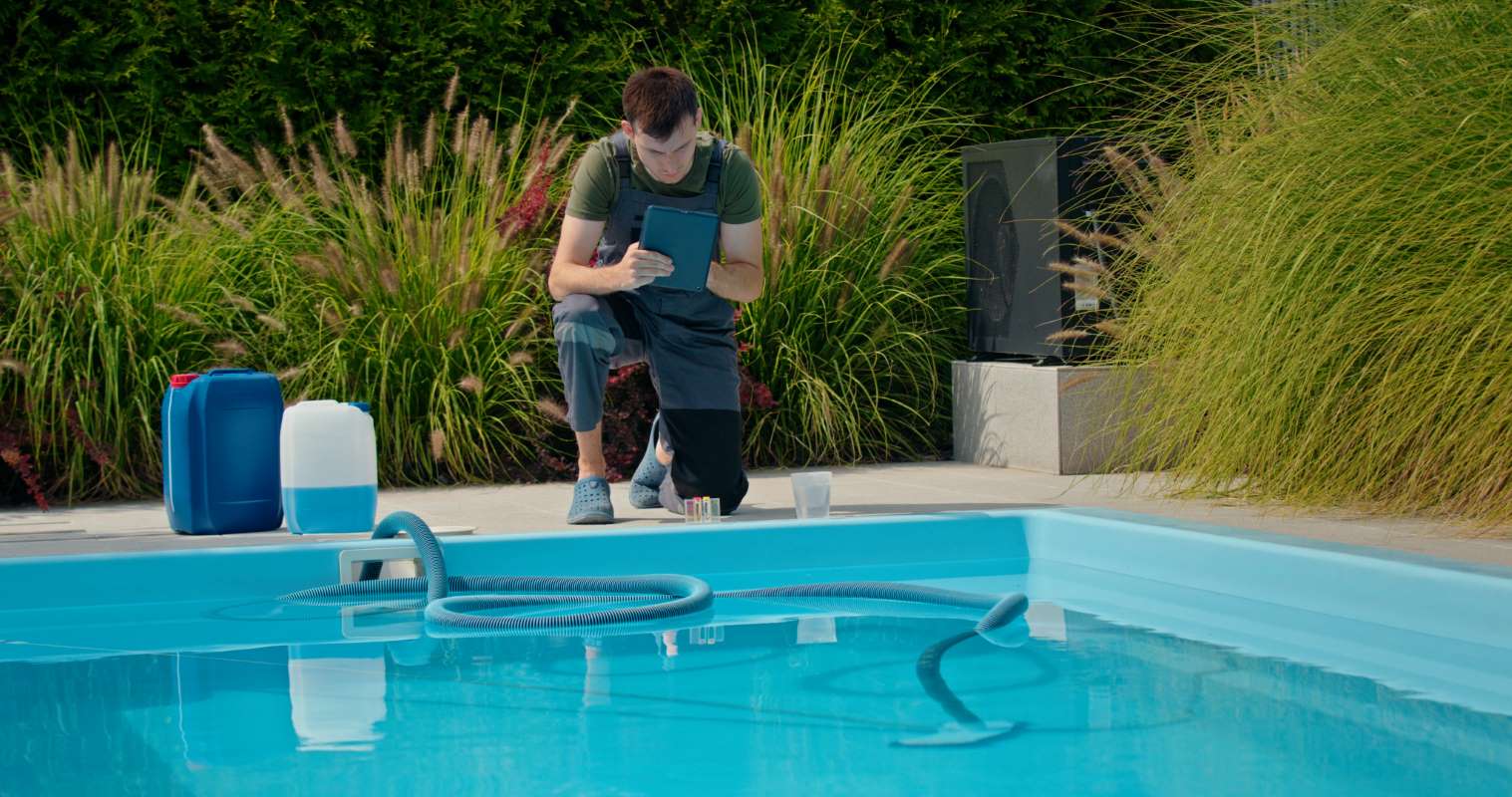
📌 Key Takeaway: Experienced pool techs service 12–18 residential pools per day in 2026. Below 10 means the route is scattered; above 20 means service quality is suffering.
How Many Pools Can One Tech Clean Per Day?
One of the most common questions from first-time pool route buyers: how many pools am I actually going to be servicing per day? The honest answer has a range — 12 to 18 residential pools per day for an experienced technician on a well-structured route in 2026 — but the range hides a lot of operational reality that determines where you fall inside it.
This post breaks down the math, the drivers that move the number up or down, and what capacity means for route sizing, pricing, and hiring decisions.
The Baseline Math
A typical residential pool cleaning visit takes 15–25 minutes of actual on-site work:
- Skimming and basket emptying: 2–4 minutes
- Brushing walls and tile: 3–6 minutes
- Water testing: 2–3 minutes
- Chemistry adjustment: 2–5 minutes
- Vacuum (if needed that visit): 4–10 minutes
- Equipment inspection: 2–3 minutes
Add 8–15 minutes of drive time between stops (on a properly clustered route), and each pool represents 23–40 minutes of the workday.
On an 8-hour workday with 30 minutes for lunch, that's 450 working minutes. At 30 minutes per pool, you service 15. At 25 minutes, you service 18. At 40 minutes (scattered route), you service 11.
What Drives the Number Up (Pools per Day Higher)
1. Geographic Density
The single biggest factor. A route where every account is within a 10-mile radius averages 8–10 minutes of drive time per stop. A route scattered across 30 miles averages 15–20 minutes per stop.
On a 15-pool day:
- Tight route: 15 × 9 min drive = 135 min total drive
- Scattered route: 15 × 18 min drive = 270 min total drive
The scattered route has spent an extra 2 hours 15 minutes driving that the tight route didn't. That's 4–5 more pools the tight route can service in the same day.
Route density is priced into a route's value — see Understanding the True Value of Pool Accounts in 2026. Superior Pool Routes builds with density in mind; scattered routes from other sellers look cheaper on billing but cost you capacity.
2. Pool Type and Condition
Newer, well-maintained pools (especially saltwater chlorination systems) take less time than older, manual-chlorine pools with heavy debris loads.
- Clean, well-maintained pool: 15–20 minutes
- Average residential pool: 20–25 minutes
- Heavy-debris or problem pool: 30–45 minutes
- Commercial pool: 45 minutes to 2 hours
A route with predominantly well-maintained pools supports 16–18/day; one with problem pools averaging 35 minutes maxes out around 10–12.
3. Equipment and Truck Setup
An optimized truck — tools where you expect them, chemicals organized, vac hose on a reel — saves 3–5 minutes per stop vs. a chaotic truck where you dig through bins for the right test strip.
Full setup guide: Pool Service Truck Setup: A Practical Build-Out Guide.
4. Chemistry Discipline
Testing water chemistry takes 2–3 minutes. Correcting a pool that's been neglected (high chlorine demand, pH swing, stabilizer depletion) takes 10–15 minutes. Consistent weekly service prevents the neglected-pool tax.
Owners who inherit routes from operators with inconsistent chemistry discipline often service 2–3 fewer pools per day for the first 2–3 months while they get every pool stabilized. After that, the number climbs back up.
5. Route Sequencing
Driving in a logical sequence (usually clockwise or counter-clockwise across the geographic cluster) vs. random order can save 15–30 minutes per day on a 15-pool route. Route optimization software (EZ Pool Biller, Skimmer, or Pool Brain — see The Best Pool Route Software & Apps, Compared) handles this automatically.
What Drives the Number Down (Pools per Day Lower)
1. Inexperienced Technician
First-year techs average 8–12 pools per day. Year-2 techs average 12–15. Year-3+ techs hit 15–18. Experience specifically reduces:
- Chemistry calculation time (memorization replaces lookup)
- Equipment diagnosis time (pattern recognition)
- Customer communication time (rhythm established)
- Drive time (internalized route sequence)
Plan for 20–30% lower capacity in a new tech's first 6 months.
2. Commercial Account Mix
Commercial accounts (HOAs, hotels, apartment complexes) take 45 minutes to 2 hours each. A tech servicing 3–4 commercial accounts plus residential may service 8–10 pools total for the day — but at much higher billing per day than a residential-only route.
3. Chemical-Delivery Constraints
Liquid chlorine and acid need restocking — usually at a supplier twice a week. If your supplier is 20 minutes out of your route, that's 40 minutes twice a week = 80 minutes/week lost. On a tight route that's 1–2 pools per week.
4. Weather and Seasonal Spikes
Heavy rain, thunderstorms, or wildfires (in CA, AZ) disrupt service. Post-storm days require extra time per pool (debris removal, chemistry reset). A tech who normally does 15/day might do 10/day for 2–3 days after a major storm.
5. First Visit on a New Account
A new-customer first visit takes 45–60 minutes, not 20. You're baselining chemistry, documenting equipment condition, and building the customer notes file. Route owners buying 40 accounts should plan the first 2 weeks at 8–10 accounts per day as they cycle through first visits.
Capacity by Route Size — What's Realistic?
| Route size | Daily target | Workweek | Notes |
|---|---|---|---|
| 25 accounts | 5 pools/day | M/W/F — 2-day/week | Part-time solo operator |
| 40 accounts | 8 pools/day | M–F — light 5-day | Solo, leaves time for admin |
| 60 accounts | 12 pools/day | M–F — comfortable | Solo, fits 8-hour day well |
| 80 accounts | 16 pools/day | M–F — full | Solo, near capacity |
| 100+ accounts | 20/day | M–Sat — overloaded | Time to hire |
Most Superior Pool Routes buyers start at 40–60 accounts — enough to generate serious monthly billing without hitting capacity. Scaling above 80 usually triggers the first hire (see How to Motivate Pool Service Employees (That Actually Stay)).
Signs You're Exceeding Capacity
- Missed visits: skipping accounts "just this week" — the start of retention problems
- Rushed service quality: customers complaining about water clarity, equipment issues missed
- Late work days: finishing at 6 PM instead of 4 PM on routine days
- Admin falling behind: invoices not sent on time, customer messages unanswered for 24+ hours
- Weekend work: consistently doing weekend catch-up for standard weekly service
Any two of these for more than two consecutive weeks means you're past sustainable capacity. Either drop accounts, raise rates to reduce volume, or hire.
⚠️ Warning: The temptation to push past 20 pools/day is real — the incremental revenue looks good on paper. In practice, above 20/day, customer retention drops noticeably within 3–6 months. You'll lose more billing to cancellations than you gain from the extra stops.
Capacity Planning for Route Buyers
When evaluating a route purchase, don't just look at account count and billing. Also calculate:
Daily pool count if you service the route solo:
- Account count ÷ 5 workdays (assuming M–F full schedule)
- Example: 60 accounts ÷ 5 = 12 pools/day = comfortable solo
Drive time assessment:
- Ask the seller what the current tech's typical workday looks like
- Red flag: "most days I'm out 8–10 hours" on a 50-account route means scattered accounts or inefficient sequencing
Buffer capacity:
- Leave 15–20% of your daily hours unbooked for emergencies, new-customer intakes, and growth
- On a 15-pool day, keep 2–3 slots as buffer — don't book to 18
The Path to Scaling Past Solo Capacity
Once you're hitting 16+ pools/day consistently, the next move is hiring a tech. The stages:
- Solo at 60–80 accounts: single operator at full capacity
- Hire first tech, route to 100–140 accounts: you keep 50–70, tech takes 50–70, both at healthy capacity
- Third tech or stay 2-man: depends on geography and growth ambitions
Full scaling playbook: The 2026 Pool Service Growth Playbook.
Common Capacity Mistakes
Buying more route than you can service solo. A 100-account route purchased before you've hired or trained a tech means missed visits in month 2. Start at 40–60, scale deliberately.
Ignoring drive time when evaluating scattered routes. Two routes at the same 60-account count can have a 4-hour-per-day drive time gap. Only one is profitable.
Not tracking minutes per pool. Most operators never measure — they just feel busy. Tracking for 2 weeks reveals exactly where the time goes.
Chasing the maximum number. 20/day at 17 minutes average is worse than 15/day at 22 minutes average. The latter customers stay; the former churn.
Pushing new techs into solo capacity too fast. Expecting a month-3 tech to hit 15/day causes burnout and churn. Plan for 10–12 in the first 6 months, climbing to 14–16 by month 12.
Related Reading from Superior Pool Routes
- The 2026 Pool Service Growth Playbook — when to scale from solo
- Pool Service Truck Setup: A Practical Build-Out Guide — equipment that saves minutes
- The Best Pool Route Software & Apps, Compared — route optimization tools
- How to Motivate Pool Service Employees (That Actually Stay) — when you're ready to hire
- What to Expect in Your First 30 Days as a Pool Route Owner — ramp-up capacity notes
- Current pool routes for sale — all sized for sensible daily capacity
Frequently Asked Questions
What's the most pools anyone can realistically service in a day? 22–25 on an extremely dense route with well-maintained pools, for an experienced technician. Above that, quality drops and retention follows within months. 18 is the practical ceiling for sustainable service quality.
Do commercial pools count as "a pool" for capacity purposes? Not directly. A commercial HOA pool typically equals 2–4 residential accounts in time and billing. Count commercial as "equivalent residential" when planning capacity.
How many pools can a brand-new technician handle? In their first month, 8–10 pools per day. Rising to 12–14 by month 3, and 14–16 by month 6. Pushing faster usually produces quality issues that cost more than the capacity gain.
Does winter slow the pace in year-round markets? Slightly. Florida and Arizona winter service is 2–3 minutes faster per pool (less algae pressure, less debris) — adding about one pool per day of capacity. Most tech owners use winter capacity for add-on services (filter cleans, equipment tune-ups) rather than adding routine accounts.
How do I know if my route is "dense enough"? Average drive time per stop over a full workday. Under 10 minutes per stop = dense. 10–15 = typical. Over 15 = scattered. Track it for one week and you'll know exactly where you are.
Ready for a Route Sized Right?
A route priced right AND structured for realistic capacity is the difference between a business that works and one that burns out its owner. Superior Pool Routes builds routes with density and capacity in mind.
Call us at 800-249-6973 or visit our Contact page to talk through account counts that match your goals. The Pricing page has the tier structure.
Pricing may vary based on location, account count, and market conditions. Contact Superior Pool Routes for a personalized quote.